MK
MK FINTECH LABGEN · INSTITUTIONAL RESEARCH

Systemic Liquidity & Spillover Lab

Game-theoretic transmission from concentrated portfolio stress to funding, corporate-bond risk, and policy stabilization.

Hypothetical / Illustrative
STRUCTURAL LIQUIDITY EVENT

From concentrated portfolios to a conditional credit event.

The framework follows a hypothetical sequence in which concentration, redemption pressure, declining market depth, tighter collateral standards and shrinking bank credit interact. The central question is not whether a credit event is inevitable, but whether a market-liquidity shock can migrate into refinancing stress and corporate-bond risk.

ConcentrationLockoutHaircutsFunding StressCredit SpreadPolicy Response
ANALYTICAL STORYLINE
01Concentrated exposure
02Redemption pressure
03Liquidity lock
04Bank collateral escalation
05Equity-value decline
06Corporate-bond spread widening
07Refinancing/default probability
08Policy stabilization game
Portfolio Concentration
→
Redemption Shock
→
Forced Sales
→
Market Depth ↓
→
Haircuts ↑
→
Bank Credit ↓
→
Refinancing Stress ↑
→
Corporate Bond Risk ↑
EVENT

Embedded Event Engine

Explains how the shock evolves mechanically: concentration, redemptions, gates, market-maker retreat, collateral escalation, and liquidity lock.

GAME

Strategic Interaction Engine

Separates strategic actors into Game Trappers, Victim Monetary Institutions, intermediaries, funding banks, investors, and public authorities.

POLICY

Dynamic Policy Engine

Tests whether credible policy intensity can reduce uncertainty, soften collateral pressure, restore market depth, and shift the system away from an adverse equilibrium.

Research framing: all institutions, markets, indices, strategies, and outcomes are fictional and illustrative. The model is a conceptual stress-testing framework, not an empirical forecast or allegation concerning any real entity.
EMBEDDED EVENT MODEL

Where the liquidity mismatch becomes visible.

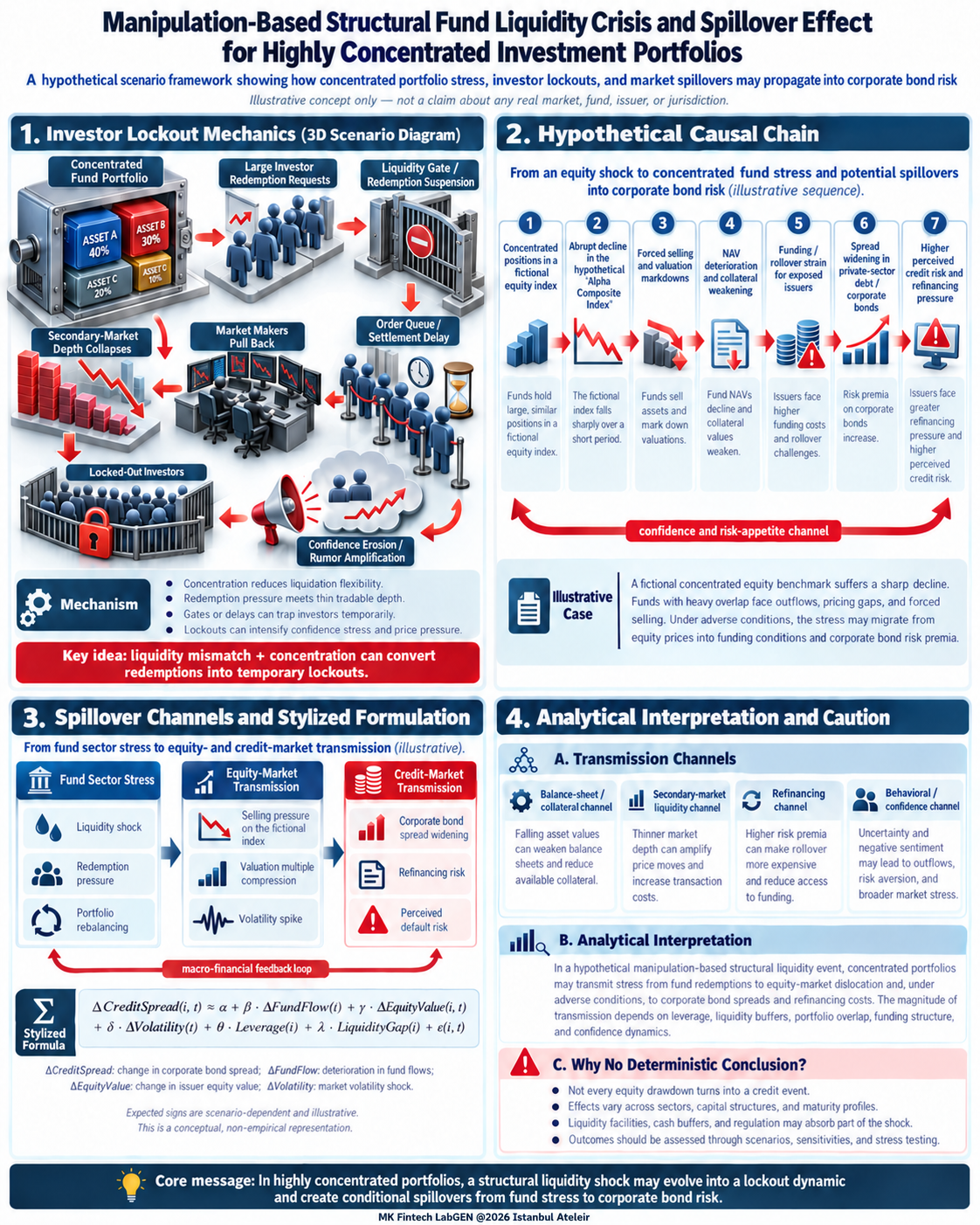
Shock mechanics
Structural fund liquidity crisis poster

Event sequence

  1. Large overlapping positions reduce liquidation flexibility.
  2. Investor redemptions force cash generation.
  3. Trading depth becomes insufficient relative to desired sales.
  4. Valuation gaps and settlement delays increase uncertainty.
  5. Gates or redemption restrictions can emerge as a temporary access-control mechanism.
  6. Rumor and confidence erosion feed back into additional redemption pressure.
LOCKOUT CONDITION
Lockoutt = 1{ Rt > Casht + SaleCapacityt + Cbankt }

A temporary lockout becomes more likely when redemption demand exceeds immediately available cash, realistic sale capacity, and bank funding capacity.
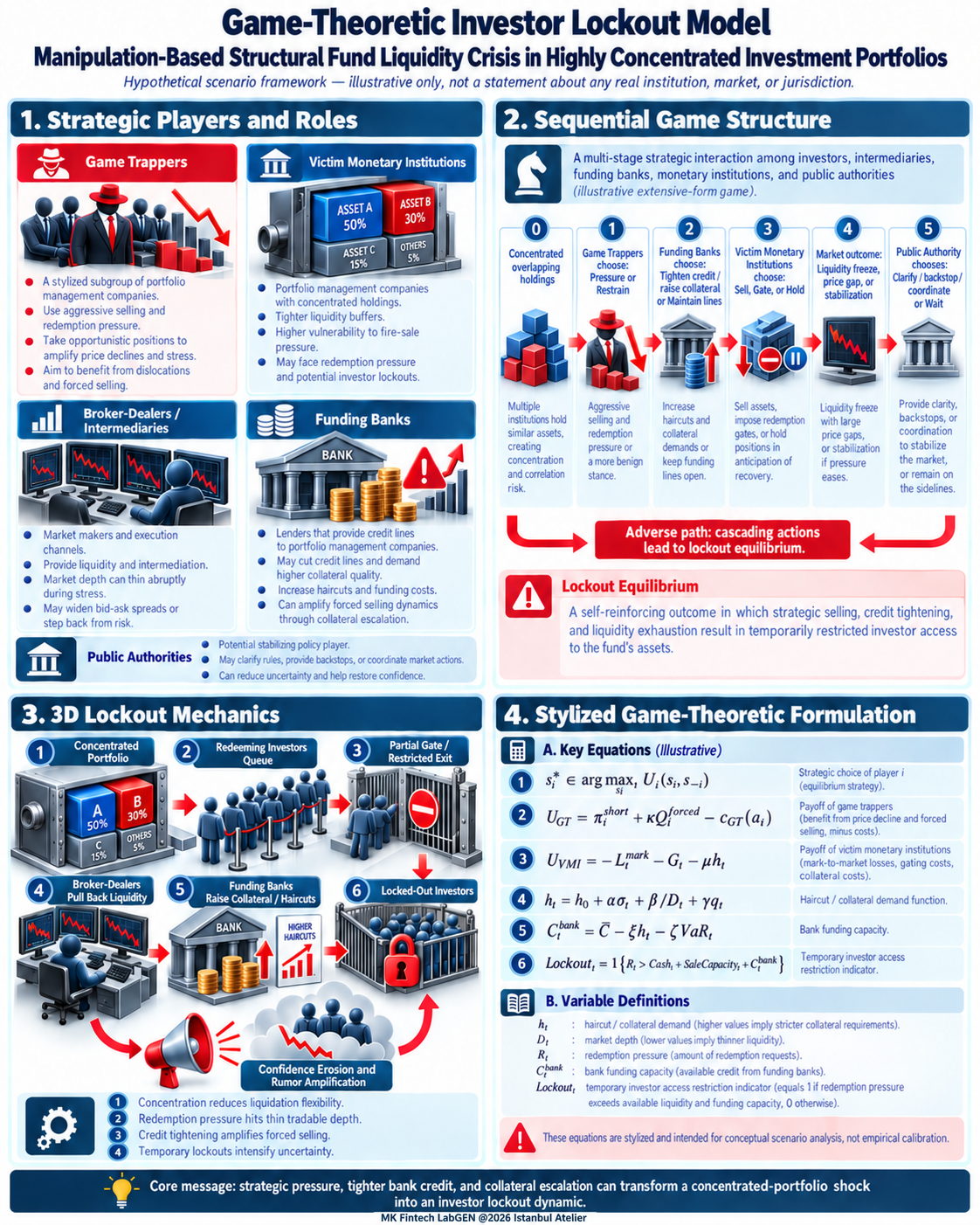
STRATEGIC CONFLICT

Game Trappers vs. Victim Monetary Institutions.

Extensive-form game
Game-theoretic investor lockout model poster

Objectives and conflict points

Game TrappersMay prefer pressure if dislocation benefits outweigh strategic costs.
Victim Monetary InstitutionsSeek to preserve NAV, liquidity, collateral and investor access while minimizing forced-sale losses.
Broker-DealersProtect balance-sheet capacity and reduce inventory risk when volatility rises.
Funding BanksProtect credit quality by reducing lines, raising haircuts, or demanding higher-quality collateral.
Public AuthoritiesMinimize system loss, uncertainty, lockout duration and credit-market spillovers.
STRATEGIC CHOICE
s*i ∈ arg max Ui(si, s−i)

The adverse equilibrium can become self-reinforcing when individually rational balance-sheet protection generates collectively damaging liquidity withdrawal.
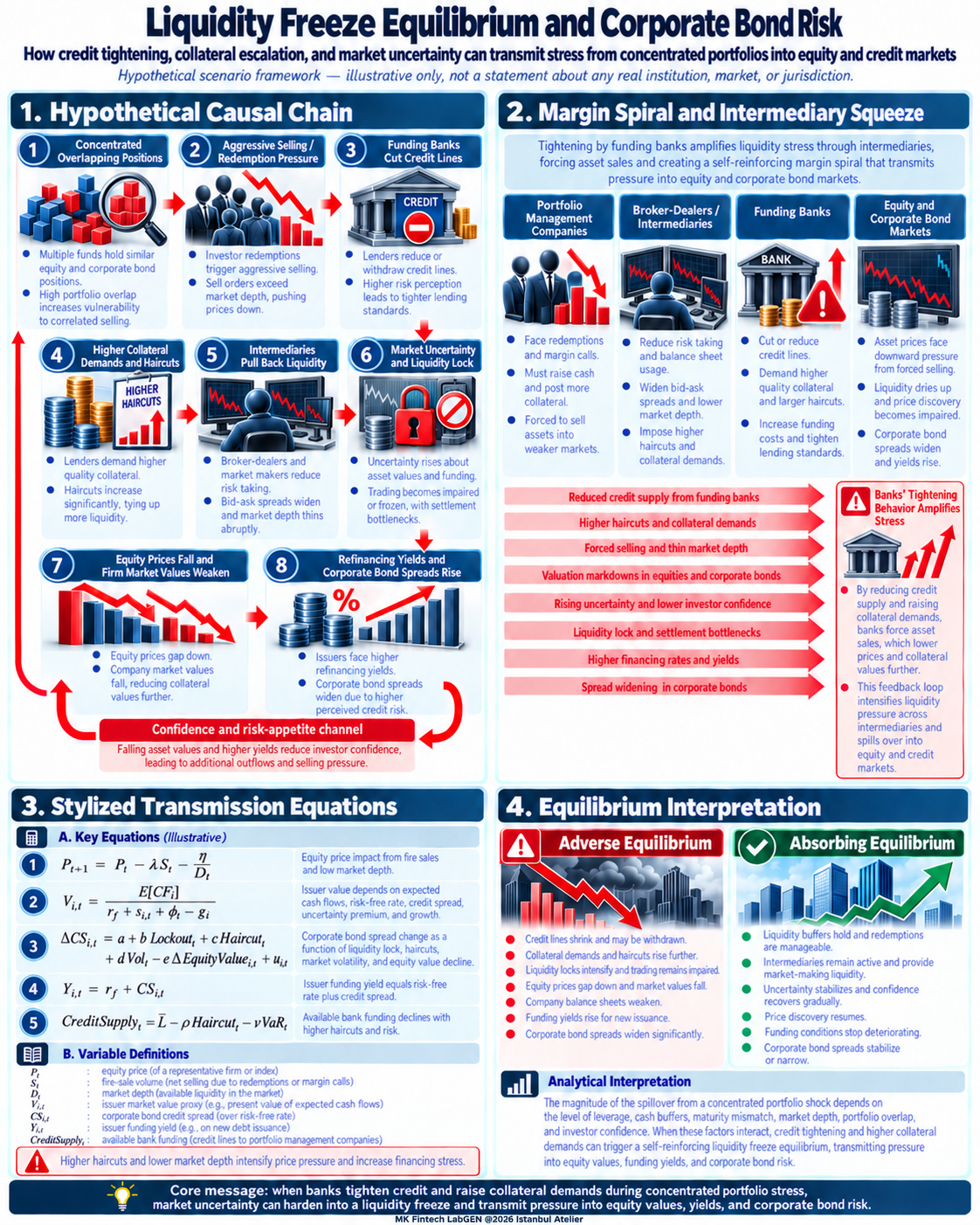
LIQUIDITY FREEZE EQUILIBRIUM

Where the system actually breaks.

Transmission bottleneck
Liquidity freeze and corporate bond risk poster

Liquidity-lock mechanism

  1. Redemptions and sell orders exceed realistic market depth.
  2. Broker-dealers pull back balance-sheet capacity.
  3. Funding banks tighten credit lines and increase collateral demands.
  4. Haircuts rise, settlement becomes less fluid and investors face valuation gaps.
  5. Price discovery weakens as uncertainty and forced sales reinforce one another.
EQUITY PRICE PRESSURE
Pt+1 = Pt − λSt − η / Dt

When fire-sale volume S rises and depth D falls, the price impact of selling increases nonlinearly. A liquidity shock can therefore depress equity values faster than fundamentals alone would imply.

BANK FUNDING CHANNEL

How collateral escalation can reduce financing access.

Balance-sheet protection
HAIRCUT FUNCTION
ht = h0 + ασt + β / Dt + γUt

Haircuts rise with volatility and uncertainty, and with the inverse of market depth. Higher h implies stricter collateral requirements.

BANK CREDIT SUPPLY
CreditSupplyt = L̄ − ρht − νVaRt − χUt

Available bank funding may decline as collateral requirements, measured risk and uncertainty increase.

1Collateral quality uncertainty
2Higher haircuts / margin calls
3Credit line reduction
4Cash buffers consumed
5Forced liquidation
6Refinancing access weakens
The model treats bank tightening as a risk-management response, not as evidence of misconduct. The systemic issue arises when many balance-sheet actors de-risk simultaneously.
CORPORATE BOND SPILLOVER

From equity-value stress to refinancing risk.

Credit transmission

Transmission story

Equity value ↓↓Collateral / balance-sheet perception weakens↓Bank credit availability ↓↓Refinancing uncertainty ↑↓Funding yield ↑↓Corporate bond spread ↑
SPREAD TRANSMISSION
ΔCSi,t = α + βLockoutt + γHaircutt + δVolt + θFundingStressi,t − λΔEquityValuei,t + εi,t

This stylized relation captures the possibility that credit spreads widen even before comparable deterioration is visible in operating fundamentals.

Key analytical proposition: a corporate-bond contagion channel can arise through refinancing capacity, collateral quality and confidence — not only through contemporaneous operating losses.
CONDITIONAL DEFAULT CHANNEL

Refinancing failure as the bridge from market stress to credit risk.

Probability, not certainty
ILLUSTRATIVE PD FUNCTION
PDi,t = Λ(β0 + β1CSi,t + β2Leveragei + β3RefinancingGapi,t − β4LiquidityBufferi − β5BankCreditAccessi,t)

Λ denotes a logistic mapping into a 0–1 probability. This is a scenario function, not an estimated default model.
When does the channel become material?

  • Large near-term refinancing gap
  • Weak liquidity buffer
  • High leverage
  • Sharp spread widening
  • Bank credit lines reduced or withdrawn
  • Low market depth in the issuer’s debt
  • Confidence shock that delays primary issuance
Important: the framework does not state that an issuer will default. It models conditions under which default probability may increase because refinancing access becomes impaired.
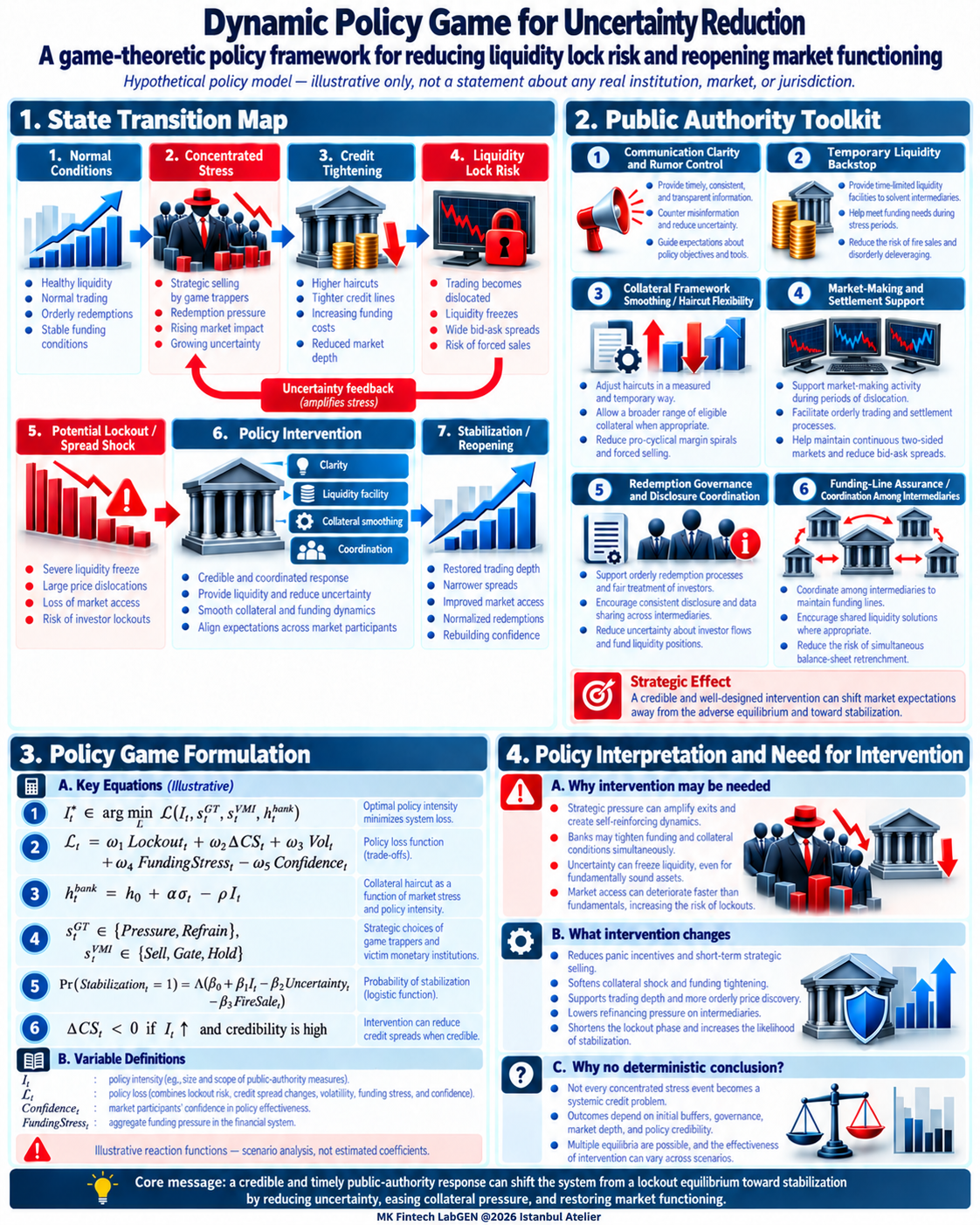
DYNAMIC POLICY GAME

Shift expectations away from lockout equilibrium.

Uncertainty reduction
Dynamic policy game poster
POLICY OBJECTIVE
I*t ∈ arg min 𝓛(It, sGTt, sVMIt, hbankt)
SYSTEM LOSS
𝓛t = ω1Lockoutt + ω2ΔCSt + ω3Volt + ω4FundingStresst − ω5Confidencet

Policy levers

  • Communication clarity and rumor control
  • Temporary liquidity backstop
  • Measured collateral-framework smoothing
  • Market-making and settlement support
  • Redemption governance and disclosure coordination
  • Funding-line coordination among intermediaries
MODEL LAB

Interactive Event Engine + Policy Engine.

Live scenario

Event Engine Inputs

Policy Engine Inputs

Liquidity Stress—/100
Equity Value Shock—%
Funding Stress—/100
Corporate Bond Spread—bp
Lockout Probability—%
Conditional PD—%
Stabilization Probability—%
State—scenario
Institutional Transmission Monitor
Normalized scenario metrics
Scenario Heat Table
Current state by transmission block
Dynamic Network / Spillover Map
Event Engine transmission across players, markets and balance sheets
Adverse Equilibrium ↔ Stabilization Frontier
Policy Engine map of stress versus intervention effectiveness
PassiveContainmentStabilization
Transmission Waterfall
Stylized contribution to spread and lockout pressure
Narrative Interpretation
Automated scenario commentary
Primary bottleneck—
Dominant channel—
Policy stance—
POLICY COUNTERFACTUAL SIMULATOR

Same shock. Four policy regimes.

Event inputs are held constant. Each regime applies a stylized policy transmission package to liquidity buffers, market depth, collateral pressure, funding access and uncertainty.

No InterventionLiquidity BackstopCollateral SmoothingFull Coordination
Counterfactual Outcome Comparison
Normalized comparison; actual values shown in the matrix
Counterfactual Outcome Matrix
Liquidity stress · lockout · spread · conditional PD · stabilization
Policy Transmission Assumptions
Stylized intervention effects applied to the same underlying shock
LiquidityStress = f(Concentration, Redemptions, 1/Depth, Haircuts, CreditCut, Volatility, Buffers, Policy) PD = Λ(Spread, Leverage, RefinancingGap, −LiquidityBuffer, −BankCreditAccess)
All Model Lab outputs are normalized scenario indicators generated by transparent stylized functions in the browser. They are not forecasts, ratings, valuation advice, or empirical estimates.
POSTER SERIES

The complete research narrative in sequence.

4 posters
01

Structural Liquidity Crisis & Spillover

System setup, investor lockout mechanics, hypothetical causal chain, spillover channels.

Poster 1Download Poster 01
02

Game-Theoretic Investor Lockout

Strategic players, extensive-form game, lockout equilibrium, payoff formulation.

Poster 2Download Poster 02
03

Liquidity Freeze & Corporate Bond Risk

Funding-bank tightening, haircut escalation, price pressure, credit spread transmission.

Poster 3Download Poster 03
04

Dynamic Policy Game

State transition, policy toolkit, intervention reaction functions and stabilization path.

Poster 4Download Poster 04